
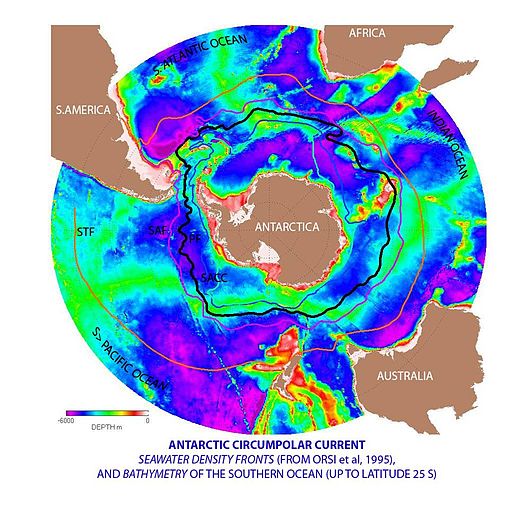
The Drake passage effect usually refers to the apparent sensitivity of the strength of the AMOC to changes in the zonal wind stress in the ACC region first reported by Toggweiler and Samuels (1993,1995). Because the effect seems to demonstrate a dependence of the AMOC on mechanical forcing, it has done much to undermine the classical buoyancy-driven view of the AMOC that had prevailed so far. Along with he subsequent study by Munk and Wunsch (1998), the Drake passage effect has contributed much to challenge the classical heat engine view of the ocean.
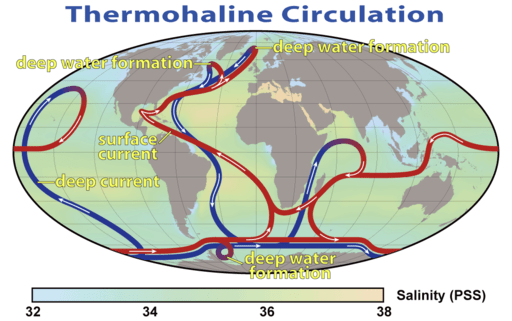
Although subsequent analysis clearly demonstrates that the Drake passage effect by no means conflict with the buoyancy-driven view of the AMOC for reasons clarified below, the correct explanation tends to be overlooked in favour of the erroneous rationalisation of the effect proposed by Toggweiler and Samuels (1993,1995).
I find it surprising that referees did not ask T&S to conduct additional diagnostics, such as showing how the distribution of surface heat fluxes vary as the souther wind stress is changed.
According to model experiments reported by the authors, the AMOC
In order to understand the effect, it is crucial to know exactly the kind of settings that the authors studied:
- These are ‘ocean-only’ model experiments forced by a restoring boundary condition in temperature;
- following a change in forcing, the model is run to a steady-state;

 The Natural Heat Engines Enquirer